The Revolution in Vehicle Design

OCTOBER 24, 2013

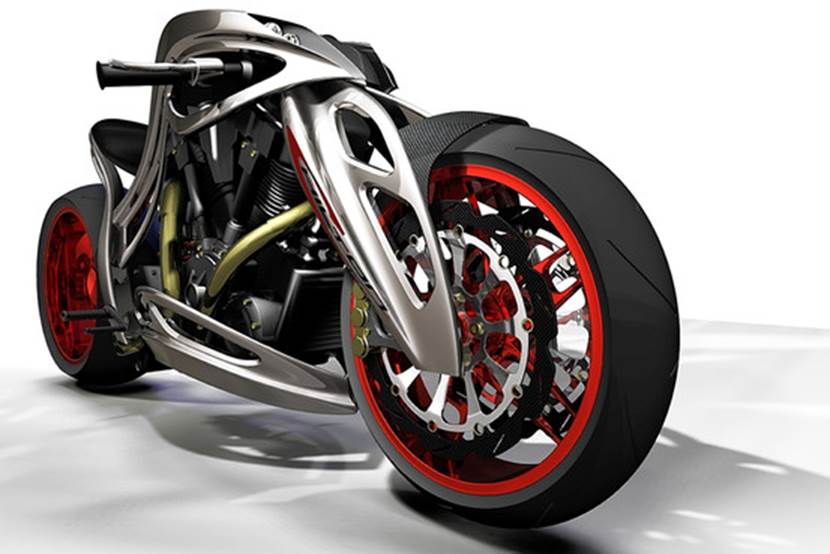
Design software produces ideal shapes for vehicle parts like this motorcycle frame

A revolution in vehicle design that has been sweeping the auto industry, writes The Wall Street Journal (Oct. 21, 2013) . Advances in computer-aided engineering (CAE) and big investments in computing power have given manufacturers new tools to create designs and the ability to test their ideas in a fraction of the time and at far less cost than they could before. The result: many more design ideas are being conceived and tested, and the best are being adopted quickly, helping manufacturers improve the fuel efficiency and their vehicles. “This new process is allowing us to do a lot of innovation,” says Ford’s head of CAE.

Car makers are using computers to run through dozens of design possibilities in the time it once took to produce a single prototype. Only a few years ago, it might have taken as long as 8 months to get from the idea for a new cylinder head to the building of a prototype, and it would have cost millions of dollars. Today, the part is created in a computer simulation that comes up with the most efficient design possible. Engineers then alter that design to account for manufacturing constraints and test the revised design virtually in models that use decades of data on material properties and engine performance as a guide. The firm then creates the mold to make a real part that can be bolted onto an engine for further testing. The entire process takes days instead of months and cost only thousands.

In the past 4-5 years, car makers have been ditching physical prototypes as computer simulations of real-world conditions improved. Costs, performance and safety designs have been digitized so they can be weighed by design programs. The vehicle can be built, run through snow banks, started in frozen or hellishly hot conditions and crashed repeatedly—all inside a network of computers.

This post provided courtesy of Jay and Barry’s OM Blog at www.heizerrenderom.wordpress.comProfessors Jay Heizer and Barry Render are authors of Operations Management , the world’s top selling textbook in its field, published by Pearson.

Goldman Sachs cafeteria’s genius pricing plan?

OCTOBER 22, 2013

goldmanGoldman Sachs’ cafeteria has been described as something out of Gattaca, the 1997 science fiction film, reports The Washington Post (Oct.18, 2013).  It’s a wide-open space full of furniture that looks like it was smuggled from a utopian future in which nothing is ever dirty, broken or unintentionally asymmetrical. It isn’t just the physical design of the 11th-floor space that creates this impression. It’s the way Goldman administers it with a clever policy designed to economically engineer efficient eating.

The most crowded time of the day to eat lunch is, naturally, during lunch time. For most people, this falls around noon. This creates the phenomenon of the lunchtime rush hour. Goldman didn’t like the idea of its people waiting on long lines to get their lunch. People are capital to Goldman. It wants to use its capital efficiently. Standing on line waiting for a burger is not an efficient use of Goldman’s capital. So the cafeteria has a set of timed discounts. If you show up before 11:30 or after 1:30, you get a 25% discount on your food.

As it turns out, Goldman folks are both especially attuned to economic incentives and ruthless about capital efficiency. Some take pride that they’ve never eaten lunch inside the “cost penalty window,” as one trader referred to the 2 hours when the discount isn’t in effect. In the cafeteria around 1:20 pm, the lines at the pay registers are empty. So are many of the tables. But the area between where the food is collected and where you pay is quite crowded. The Goldman lunchers are chatting with each other, waiting for the final minutes to tick down until they can save a dollar or two.   When its spokesman was called about Goldman’s lunch market manipulation, neither he nor anyone else in his office was available around 1:30. “Goldman approves of employees using their capital efficiently,” he said later.

This post provided courtesy of Jay and Barry’s OM Blog at www.heizerrenderom.wordpress.comProfessors Jay Heizer and Barry Render are authors of Operations Management , the world’s top selling textbook in its field, published by Pearson.
3-D Printers vs. European Guns Laws

OCTOBER 21, 2013

The Liberator hand gun's files were downloaded 100,000 times in 2 days

The gun fired four shots into a gelatin block,” writes The New York Times (Oct. 18, 2013). Each nine-millimeter bullet punched deep into the substance, which was meant to mimic the density of a human body. For the experts at the Austrian Interior Ministry performing the test, it was a clear sign: This was a deadly weapon. But it was no ordinary gun. The officials had downloaded the gun’s digital blueprints from the Internet and “printed” the weapon on a type of 3-D printer that any person could buy online for about $1,360. It took the Austrian authorities $68 worth of plastic polymer, built up layer by layer according to the software instructions, to make the gun.

Law enforcement agencies across Europe are on alert over the proliferation of gun-making software that is easily found on the Internet and can be used to make a weapon on a consumer-grade 3-D printer. In May, after a 25-year-old law student from Texas posted designs for a 3-D-printed handgun online, the files were downloaded more than 100,000 times in just 2 days before the State Department demanded they be removed. Stoking the anxiety have been well-publicized examples in recent months of people evading airport-style security scanners with 3-D-printed plastic weapons, whose only metal components are firing pins no bigger than a short common nail. Last summer, an Israeli TV reporter successfully toted a 3-D-made handgun into the Israeli parliament, where Prime Minister Netanyahu was giving an address.

The manufacture of weapons using 3-D printers is already banned by a European Union directive to member nations. Enforcing that rule, however, may prove a challenge. A total of 35,508 personal printers were sold worldwide last year, up nearly 50% from 2011. Most of these machines were sold to hobbyists, engineering students, and colleges. Tightening airport security might be one possible response, according to the German Police Union. “It is quite conceivable that this technical development will make full-body scanners at airports mandatory.”

This post provided courtesy of Jay and Barry’s OM Blog at www.heizerrenderom.wordpress.comProfessors Jay Heizer and Barry Render are authors of Operations Management , the world’s top selling textbook in its field, published by Pearson.