Shipping Bottleneck Hit UPS on Xmas Eve

DECEMBER 29, 2013

ups deliveryIn the earliest hours of Dec. 24, packages poured into UPS’s main hub, called Worldport, in Louisville, Ky. And they were piling up. Employees responsible for sorting packages—already deep into a 100-hour week—were furiously getting them ready to be sent on to their destinations. But dozens of other workers responsible for loading those packages into planes to be shipped out were left standing around idle, because the unexpected glut of packages from last-minute shoppers had swamped the company’s air fleet.

The dearth of planes stranded a large volume of packages in Louisville that day. Many of those that did make it out were shipped too late to make delivery trucks’ pickup schedules and were left sitting in warehouses not far from their destinations. By sundown, UPS was forced to tell many Americans that the gifts they had ordered wouldn’t arrive before Christmas as promised.

“The bottleneck was largely in UPS’s air business,” writes The Wall Street Journal (Dec.27, 2013), ”which retailers leaned on heavily in the past week as they scrambled to fill down-to-the-wire orders.” UPS originally expected to ship about 3.5 million packages at Worldport. The facility handles on average 1.6 million packages a day. Likely double that many packages arrived during the last-minute crush. On Christmas Eve UPS admitted that the volume of air packages in its system had exceeded its capacity.

UPS carefully plans how it will handle the holiday peak. Extra resources such as additional cargo planes had been lined up as “hot spares”— aircraft that could be fired up quickly in case of a logistics emergency. But it ran into a confluence of factors. Retailers have been encouraging online sales, and they likely contributed to the logjam by offering some of their best discounts late in the season in a final push for sales.

This post provided courtesy of Jay and Barry’s OM Blog at www.heizerrenderom.wordpress.comProfessors Jay Heizer and Barry Render are authors of Operations Management , the world’s top selling textbook in its field, published by Pearson.

From Navy Oil Tankers to Amazon’s Diapers

NOVEMBER 27, 2013

8 ships returning to Caroline Islands anchorage, 1944

Amazon’s online diaper sales and the U.S. Navy’s refueling protocol for World War II appear unrelated and worlds apart. Nevertheless, they are both answers to an identical logistics problem: how can an organization shorten the time between a customer’s order and a supplier’s response?

Amazon is seeking a way to decrease its response time to online buyers. In the case of diapers, this means encouraging a supplier such as P&G to relocate its operations adjacent to Amazon’s warehouses. With co-location, both firms presumably can reduce their shipping costs, better manage their inventories, and speed up deliveries.

The Navy experienced a similar logistics problem during World War II, writesThe Wall Street Journal (Nov.25, 2013). In the early months of the war, the Pacific fleet engaged in hit-and-run tactics; it had to return to Pearl Harbor, where its oil supply tanks were located. When the Navy launched a 1943 offensive in the central Pacific, the geographical distance between consumer (fleet) and supplier (Hawaii) widened. Refueling consumed a precious commodity—time.

One  logistic solution: seize an enemy-held island, convert the island into an advanced base and construct oil-storage facilities for the fleet. That worked, but as the Navy accelerated its offensive, it outran the advanced base network. By 1944, the Navy introduced floating bases at Pacific anchorages. Commercial tankers delivered fuel oil to the anchorage, storing oil in barges. A gap, though, between oil demand and supply still persisted.

Then the Navy turned logistics on its head, dispatching 36 oilers to meet carrier task force units at prearranged locations in the forward area. Oilers now refueled fleet units on the move in “underway replenishment.” The results were dramatic. A carrier task force could remain free from a fixed base for 3 months. Fleet Admiral Nimitz termed the Pacific just-in-time supply chain as his “secret weapon.” Naval historians would describe Nimitz’s logistic plan as a “fleet within a fleet.” Amazon’s co-location has been called a “plant within a plant.”

This post provided courtesy of Jay and Barry’s OM Blog at www.heizerrenderom.wordpress.comProfessors Jay Heizer and Barry Render are authors of Operations Management , the world’s top selling textbook in its field, published by Pearson.
The Revolution in Vehicle Design

OCTOBER 24, 2013

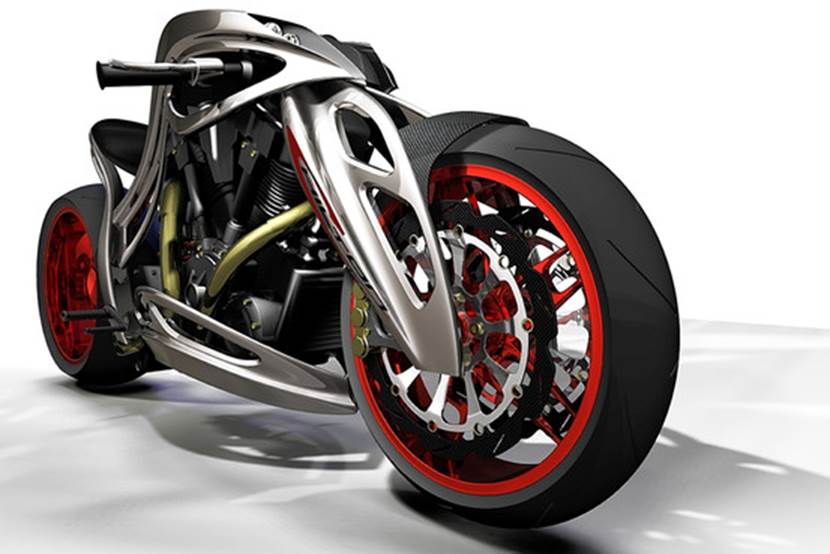
Design software produces ideal shapes for vehicle parts like this motorcycle frame

A revolution in vehicle design that has been sweeping the auto industry, writes The Wall Street Journal (Oct. 21, 2013) . Advances in computer-aided engineering (CAE) and big investments in computing power have given manufacturers new tools to create designs and the ability to test their ideas in a fraction of the time and at far less cost than they could before. The result: many more design ideas are being conceived and tested, and the best are being adopted quickly, helping manufacturers improve the fuel efficiency and their vehicles. “This new process is allowing us to do a lot of innovation,” says Ford’s head of CAE.

Car makers are using computers to run through dozens of design possibilities in the time it once took to produce a single prototype. Only a few years ago, it might have taken as long as 8 months to get from the idea for a new cylinder head to the building of a prototype, and it would have cost millions of dollars. Today, the part is created in a computer simulation that comes up with the most efficient design possible. Engineers then alter that design to account for manufacturing constraints and test the revised design virtually in models that use decades of data on material properties and engine performance as a guide. The firm then creates the mold to make a real part that can be bolted onto an engine for further testing. The entire process takes days instead of months and cost only thousands.

In the past 4-5 years, car makers have been ditching physical prototypes as computer simulations of real-world conditions improved. Costs, performance and safety designs have been digitized so they can be weighed by design programs. The vehicle can be built, run through snow banks, started in frozen or hellishly hot conditions and crashed repeatedly—all inside a network of computers.

This post provided courtesy of Jay and Barry’s OM Blog at www.heizerrenderom.wordpress.comProfessors Jay Heizer and Barry Render are authors of Operations Management , the world’s top selling textbook in its field, published by Pearson.