Cluster Analysis in the Mojave Desert

JANUARY 3, 2014

Cluster of 17 "New Space" companies in Mojave Desert

IT BEGAN with a boom. In 1947, Chuck Yeager became the first man to break the sound barrier. He flew from Edwards Air Force Base in the Mojave Desert, America’s main center for experimental military flights. This base was out-of-the-way of prying eyes and surrounded by landscape into which a crash (and there were many) would not inconvenience anyone. Now, reports The Economist (Dec.21,2013-Jan. 4, 2014), the Mojave Desert is emerging as the site of a cluster of what has come to be known as New Space.

The center of activity is 20 miles from Edwards, around the Mohave civilian airfield, now dubbed the Mojave Air and Space Port (see photo). Today, 17 rocket and space-related companies operate in the Air and Space Port. Most hope to make their money from launching satellites. Two, though, plan to enter the trade of taking tourists into space.Scaled Composites has designed and built SpaceShipTwo, a rocket plane intended to carry paying passengers to 100km above Earth using a hybrid rocket engine. Competitor XCOR’svehicle, Lynx, plans to fly this year.  It, too, is a rocket plane, but is designed to take off from a runway under its own power.

Stratolaunch Systems proposes to take the air-launched-rocket principle and push it to the limit.  Orbital Sciences makes an air-launched rocket, Pegasus, which is used to put satellites into orbit, and the firm also has a contract to resupply the International Space Station. Firestar Technologies is developing a liquid fuel that requires only one tank and no complicated mixing mechanism in the motor, which simplifies engineering. Interorbital Systems is designing small, cheap rockets that can be strapped together in bundles, using as many as are necessary to lift a given payload into orbit.

This post provided courtesy of Jay and Barry’s OM Blog at www.heizerrenderom.wordpress.comProfessors Jay Heizer and Barry Render are authors of Operations Management , the world’s top selling textbook in its field, published by Pearson.


The Explosion of 3D Printing at GE

DECEMBER 11, 2013

GE produces one of the world's most powerful engines

GE, on the hunt for ways to build more than 85,000 fuel nozzles for its new Leap jet engines, is making a big investment in 3D printing, reports BusinessWeek (Dec. 2-8, 2013). Usually the nozzles are assembled from 20 different parts. Also known as additive manufacturing, 3D printing can create the units in one metal piece, through a successive layering of materials. The process, discussed in Chapter 5,  is more efficient and can be used to create designs that can’t be made using traditional techniques. The finished product is stronger and lighter than those made on the assembly line and can withstand the extreme temperatures (up to 2,400F) inside an engine. There’s just one problem: today’s industrial 3D printers don’t have enough capacity to handle GE’s production needs.

“With today’s technology, it would take too many machines,” as many as 60 to 70, to efficiently make the nozzles, says GE. As part of a $3.5 billion investment in its aerospace supply chain, GE will spend tens of millions of dollars to invest in new technology and, over the next five years, triple the size of its 70-person 3D-printing staff and expand its factory floor fourfold.

The company’s embrace of 3D printing throws the weight of the world’s largest jet-engine maker behind the technology. Today, Boeing uses the process to make plastic air-conditioning ducts for its 787 jet, and Nike has a football cleat made on 3D printers. But “GE’s investment changes everything, and it’s also unprecedented,” says an industry expert. Expanding 3D printing will give GE clout with manufacturers, an opportunity to guide the growth of the industry. “There doesn’t exist a supply chain out there right now for this kind of work,” a GE VP says. “GE has to be involved in developing it.”

This post provided courtesy of Jay and Barry’s OM Blog at www.heizerrenderom.wordpress.comProfessors Jay Heizer and Barry Render are authors of Operations Management , the world’s top selling textbook in its field, published by Pearson.
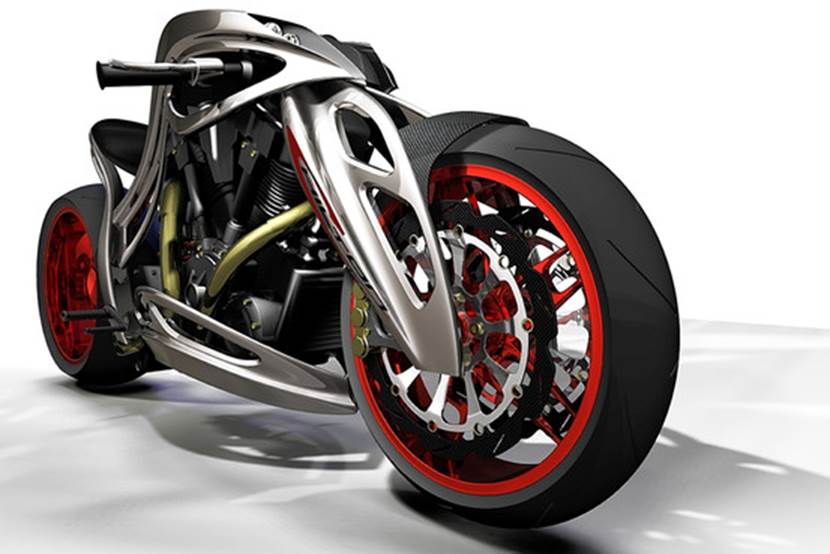
The Revolution in Vehicle Design

OCTOBER 24, 2013

Design software produces ideal shapes for vehicle parts like this motorcycle frame

A revolution in vehicle design that has been sweeping the auto industry, writes The Wall Street Journal (Oct. 21, 2013) . Advances in computer-aided engineering (CAE) and big investments in computing power have given manufacturers new tools to create designs and the ability to test their ideas in a fraction of the time and at far less cost than they could before. The result: many more design ideas are being conceived and tested, and the best are being adopted quickly, helping manufacturers improve the fuel efficiency and their vehicles. “This new process is allowing us to do a lot of innovation,” says Ford’s head of CAE.

Car makers are using computers to run through dozens of design possibilities in the time it once took to produce a single prototype. Only a few years ago, it might have taken as long as 8 months to get from the idea for a new cylinder head to the building of a prototype, and it would have cost millions of dollars. Today, the part is created in a computer simulation that comes up with the most efficient design possible. Engineers then alter that design to account for manufacturing constraints and test the revised design virtually in models that use decades of data on material properties and engine performance as a guide. The firm then creates the mold to make a real part that can be bolted onto an engine for further testing. The entire process takes days instead of months and cost only thousands.

In the past 4-5 years, car makers have been ditching physical prototypes as computer simulations of real-world conditions improved. Costs, performance and safety designs have been digitized so they can be weighed by design programs. The vehicle can be built, run through snow banks, started in frozen or hellishly hot conditions and crashed repeatedly—all inside a network of computers.

This post provided courtesy of Jay and Barry’s OM Blog at www.heizerrenderom.wordpress.comProfessors Jay Heizer and Barry Render are authors of Operations Management , the world’s top selling textbook in its field, published by Pearson.